How to Use a 1031 Exchange in Las Vegas Real Estate

A 1031 exchange is one of the few legal tools left in U.S. real estate that lets an investor sell a property, roll the entire proceeds into another one, and push the capital gains tax bill into the future. In Las Vegas, where investors have been buying and trading rentals for two decades, the mechanics are well understood at the broker level but full of local quirks that can quietly torch a deal if you don't know about them.
This guide walks through how a 1031 exchange Las Vegas guide actually works on the ground here: the federal rules, the Nevada-specific facilitator licensing nobody talks about, what Clark County still charges you at closing, and the short-term rental traps that turn perfectly valid exchanges into useless replacement properties. If you're planning to roll a Las Vegas rental into something better, or you're moving 1031 money into Southern Nevada from another state, this is the version I wish more investors read before they signed anything.
What a 1031 Exchange Actually Does (and Doesn't Do)
The thing most people get wrong about a 1031 is the word "exchange." Nobody is literally swapping deeds with another investor. In practice, a 1031 is a sale and a purchase that the IRS agrees to treat as a single transaction, as long as you follow the structure. You sell your relinquished property, the proceeds go to a qualified intermediary instead of into your hand, and you use that money to buy a replacement.
What you get back is tax deferral, not tax forgiveness. The capital gain rolls forward into the new property's basis. You'll pay it eventually if and when you sell that replacement outright. A lot of Vegas investors string several exchanges together over a couple decades and let the deferral keep compounding, which is genuinely powerful. But it isn't free money, and it isn't a magic exit from every tax. It's a very specific federal tool with a very specific use case.
To qualify, the property has to be held for investment or business use. A primary residence doesn't count. Neither does a flip you bought specifically to resell. The IRS treats fix-and-flips as inventory, not investment, and that's one of the most common ways exchanges get disqualified after the fact.

The Two Deadlines That Make or Break Every Exchange
Every 1031 lives or dies on the same two clocks, both starting the day your relinquished property closes:
Forty-five days sounds like a long time until you're in it. By the time the relinquished sale closes, you're already looking at title issues, lender turn times, inspection periods, and the inevitable inventory problems in whatever specific corner of the Vegas market you actually want to be in. Investors who wait until after their sale closes to start shopping have, in my experience, the highest failure rate. The smarter approach is to be deep into replacement-property research before your relinquished property even hits the MLS.
The 180-day clock has its own nuance. If your relinquished sale closes near the end of the year, your tax-return due date can actually shorten the 180-day window unless you file an extension. CPAs handle that, but it has to be flagged early.


Why Your Qualified Intermediary Matters More in Nevada
Here is a detail almost no out-of-state article will tell you: Nevada actually licenses exchange facilitators. Under NRS Chapter 645G, an "exchange facilitator" (which includes the qualified intermediary holding your funds) is regulated by the state when the relinquished property is in Nevada or when the QI maintains a Nevada office to solicit this work. The Nevada Mortgage Lending Division maintains license-search resources you can use to verify standing.
Most states have no licensing regime for this at all. People pick a QI based on price, brand recognition, or whoever the listing agent recommends. That can work, but it leaves you with no real backstop if the QI goes sideways. There have been QI failures in U.S. real estate history serious enough that the IRS issued specific guidance for failed exchanges where the intermediary defaulted with client money. Nevada's licensing layer doesn't eliminate that risk, but it adds a verification step you'd be foolish to skip.
- Confirm the QI is licensed in Nevada under NRS 645G if your relinquished property sits in the state
- Ask exactly how exchange funds are held (segregated escrow account or commingled)
- Get the written exchange agreement and escrow instructions in place before the relinquished sale closes
- Make sure escrow knows the proceeds go to the QI, not to you, even briefly
- Verify standing on the Nevada Mortgage Lending Division license search
The "constructive receipt" rule is what trips up DIY investors most. If you have any access to the proceeds, even for a day, even sitting in your personal account, the entire exchange can be busted and the gain becomes taxable. It's why the QI engagement has to happen before the relinquished sale closes, not after.
What You Still Pay Locally When You Close in Clark County
A 1031 defers federal capital gains tax. That's it. Every other line item on your closing statement still applies. Investors moving into Vegas from California or other high-tax states sometimes assume the 1031 wraps everything up neatly. It doesn't.
The biggest local line is Real Property Transfer Tax. Per the Clark County Recorder, transfer tax is calculated at $2.55 per $500 of value or any fraction of $500, charged on the full price (or estimated fair market value, if the deed transfer is structured oddly). It's collected at recording. There are exemptions for certain transfers, but a normal investor-to-investor sale is not one of them.
| Sale or Transfer Value | Estimated Clark County RPTT | Who Typically Pays |
|---|---|---|
| $300,000 | ~$1,530 | Seller (negotiable) |
| $500,000 | ~$2,550 | Seller (negotiable) |
| $750,000 | ~$3,825 | Seller (negotiable) |
| $1,000,000 | ~$5,100 | Seller (negotiable) |
| $2,000,000 | ~$10,200 | Seller (negotiable) |
Property taxes work differently in Nevada than people expect, and that matters when you're underwriting a replacement. Per the Clark County Assessor, taxable value isn't simply your purchase price. The county uses the land's market value plus the replacement cost of improvements, less a 1.5% annual depreciation factor up to 50 years. Real property is then assessed at 35% of that appraised value for taxation purposes. Your purchase price doesn't reset the bill the way it does in Texas or Florida.
Nevada also has tax abatement caps. Owner-occupied primary residences are capped at 3% annual increases. Most investment property and commercial buildings are capped at up to 8%. That's a meaningful difference in long-run holding cost between a rental you live in part of the year and one you don't.
The Las Vegas Market Right Now and Why It Matters
The strategic case for a Las Vegas exchange in 2025-2026 is built on a tension that's worth understanding. The long-run growth story is intact. Per the U.S. Census Bureau, Clark County's population was estimated at roughly 2.41 million as of July 1, 2025, and the City of Las Vegas itself was estimated at about 678,922 in the 2024 vintage data, among the larger numeric population gains of any U.S. city year-over-year.
At the same time, near-term investor demand has cooled. Redfin data showed Las Vegas investor purchases down 20% year-over-year in Q3 2025 (the biggest decline among the metros they tracked) and down 12% year-over-year in Q4 2025. Redfin reported Las Vegas housing supply rose 31% year-over-year in July 2025, the largest increase among major metros in that report. And cash buyers are still active, accounting for 28.0% of December 2025 Las Vegas purchases per Redfin.
The multifamily market is also a lot easier to shop than it's been in a while. Per Colliers' Las Vegas Multifamily Q4 2025 research, Southern Nevada vacancy was 5.8% with average asking rent of about $1,449 per unit, or $1.56 per square foot. Inventory grew by 1,151 units in that quarter alone. For an exchanger trying to scale from a single-family rental into a duplex, fourplex, or small apartment building, that's a workable market, not a frenzied one.
Best Replacement-Property Paths for a Las Vegas Exchange

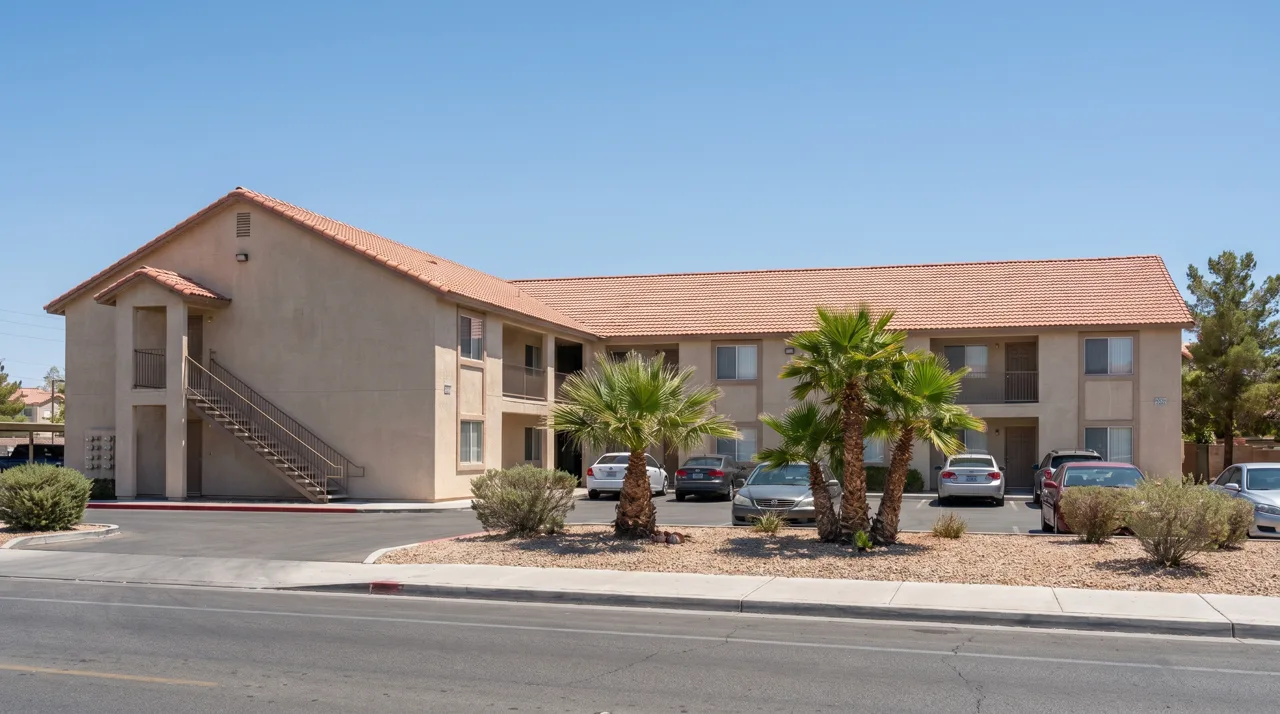
Most Vegas exchanges aren't really about trading one rental for a "better" rental. They're about trading the operational profile: fewer units versus more units, less management, a different tenant mix, a different neighborhood, a different lease structure. Here are the patterns I see most often:
Older single-family rental → newer SFR in a master-planned community
The reason is almost always maintenance. A 1985 build in the central valley is at the age where the AC, the roof, and the plumbing are all running on borrowed time. Trading into a newer build in Henderson or the northwest can cut major-systems risk for years. The trade-off is a higher HOA, slower rent growth in some submarkets, and a more competitive purchase market.
Condo or townhome rental → duplex, fourplex, or small multifamily
Investors trade out of HOA exposure all the time. HOA dues compress yields, special assessments are unpredictable, and rental restrictions are getting tighter in some communities. Moving into small multifamily replaces one HOA bill with one shared roof and one set of utility-stub headaches. Vacancy is currently around 5.8% per Colliers, which makes this trade less stressful than it was in 2022.
Residential rental → small commercial (retail strip, office condo, industrial condo)
This is the one most residential investors don't consider but probably should. Triple-net leases push the operational burden onto the tenant. CBRE's Las Vegas industrial vacancy was 8.8% in Q1 2026 with two straight quarters of improvement, and the office market also strengthened in the same quarter. Industrial condos and small commercial are real options for investors who want to stop being a landlord in the residential sense.
Active rental → DST (Delaware Statutory Trust) or TIC interest
For investors who want completely passive replacement property, fractional ownership through a DST or TIC can satisfy 1031 rules. You give up control, you depend on a sponsor, and liquidity is limited. But it solves the "I don't want to be a landlord anymore" problem without busting the exchange. This is a CPA conversation more than a broker conversation.
Strip-adjacent or tourism-sensitive rental → suburban workforce rental
Vegas rentals that depended on tourism and convention traffic during the 2010s are a different animal than they used to be. A lot of investors have rolled into more boring, more reliable workforce rentals farther from the Strip. Less upside, less drama. The valley has plenty of those, and the broader Las Vegas market guide has more context on submarkets.


The Short-Term Rental Trap Almost Nobody Warns You About
This is the one I see catch out-of-state buyers most often. A 1031 exchange can be technically valid (perfect timing, clean QI handling, deeds recorded) and still be a complete business failure if the replacement property doesn't allow the use you bought it for.
Unincorporated Clark County adopted its short-term rental ordinance on June 21, 2022. It treats STRs as commercial businesses, caps license counts by area, and enforces a 1,000-foot distance separation between licensed short-term rentals. The City of Las Vegas defines short-term rentals as 31 consecutive days or fewer and maintains its own license map and ordinance.
The practical takeaway: if your exchange thesis is "I'll roll my California rental into a Vegas Airbnb," you need to verify the specific address, jurisdiction, and HOA rules before you identify it as a replacement. Not after. A property in the right zone with the wrong HOA, or in the wrong jurisdiction with the right HOA, is still a dead deal for STR purposes.
Common Las Vegas 1031 Mistakes
Most failed exchanges I've seen weren't failed for esoteric reasons. They failed for the same handful of avoidable ones.
- Waiting to shop until after closing. Forty-five days disappears, especially when buyers want a specific school zone, HOA setup, or STR-eligible address.
- Assuming any rental can become a short-term rental. See above. City rules, county rules, and HOA rules all stack, and any one of them can kill the strategy.
- Underestimating HOA economics on condos. Rising HOA fees and special assessments have squeezed condo investing nationally. The math can change a lot in three years.
- Picking a QI on price alone. Cheapest QI is not a strategy. Verify Nevada licensure and ask how funds are segregated.
- Confusing assessed value, taxable value, and purchase price. Nevada's 35% assessed-value rule and depreciation factor mean your tax bill won't behave like in California or Texas.
- Receiving boot you didn't plan for. Cash kept out of the exchange, debt not replaced, or trading down in value all create taxable boot. If you don't model it before closing, you find out at tax time.
- Treating a 1031 as a closing-cost waiver. Federal gain is deferred, but Clark County RPTT, recording fees, lender costs, inspections, and title work all still apply.
As a CRS-designated Top 1% Las Vegas agent who's worked through quite a few of these from the broker side, the pattern I see most often is timing. Investors who lose exchanges almost never lose them on the rules. They lose them on the calendar.
When Staying in Vegas Makes Sense, and When It Doesn't
Not every Vegas seller should reinvest in Vegas. Sometimes the better exchange is into another state entirely, somewhere like Phoenix, Boise, Reno, or Texas, depending on goals. The honest answer is that it depends on what the relinquished property is and what the replacement is supposed to do for the portfolio.
Staying in Las Vegas tends to make sense when:
- You already understand local submarkets, schools, and HOA quirks well enough to underwrite quickly inside the 45-day window
- You want exposure to the long-run population growth story without learning a new market
- Your replacement is a clear upgrade in operational profile (newer build, better location, less management)
- You're rolling residential into local commercial where you already have a feel for the tenant and lease economics
Exchanging out of Nevada makes more sense when the trade is really about diversification, when local rules block the use case (the STR problem above), or when a specific out-of-state market simply offers better cap rates or rent-to-price ratios for the dollar amount you have in escrow.
The Practical Workflow, Step by Step
1. Pre-sale planning
CPA, attorney, broker, and QI align on goals, timing, and tax exposure. Verify Nevada QI licensure up front. Start replacement-property research before listing the relinquished property, not after.
2. Engage the QI before closing
The exchange agreement and escrow instructions must be signed before you close on the relinquished property. The IRS safe harbor depends entirely on you avoiding actual or constructive receipt of the proceeds.
3. Close the relinquished sale
Escrow wires the proceeds to the QI, not to you. Clark County transfer tax and recording fees still apply at the standard $2.55 per $500. The 45-day and 180-day clocks both start the day this closes.
4. Identify replacement property in writing within 45 days
This is a written notice to the QI. The IRS has formal identification rules (commonly the three-property rule, the 200% rule, or the 95% rule). Your QI and CPA will guide you through which fits.
5. Underwrite the local operating realities
HOA dues and CC&Rs, STR legality at city/county level, property tax under the Nevada 35% assessment rule, expected rents, insurance, deferred maintenance. Skipping this step is how 1031s become bad investments after closing.
6. Acquire by day 180
Close on the replacement. Year-end exchanges may need a tax-return extension to preserve the full 180-day window.
7. Post-closing compliance
Your CPA reports the exchange, tracks the carried-over basis, and makes sure depreciation schedules reset correctly on the new property. The deferred gain rides along with the new asset until you eventually sell outright (or do another exchange).


Frequently Asked 1031 Questions in Las Vegas
Can I do a 1031 with my primary residence?
No. The 1031 only applies to property held for business or investment. A primary residence falls under different rules (Section 121 home-sale exclusion). The two can sometimes be sequenced together if a property has been converted between uses for a long enough period, but that's a CPA conversation.
Can I exchange a Vegas rental into a property in another state?
Yes. Like-kind for real property is broad, and U.S. investment real estate can generally be exchanged for other U.S. investment real estate regardless of state. Many Vegas investors trade out to Phoenix, Boise, or Texas markets, and many out-of-state investors trade into Vegas.
Do I have to reinvest every dollar?
To fully defer the gain, yes. That means equal or greater value, equal or greater equity, and equal or greater debt replacement (or new equity) on the replacement side. Anything held back becomes taxable boot. Partial exchanges are allowed; you just pay tax on the boot portion.
What's the difference between a delayed exchange and a reverse exchange?
The standard delayed (or "Starker") exchange is sell first, then buy within 180 days. A reverse exchange flips that. You acquire the replacement property first through an exchange accommodation titleholder, then sell the relinquished one within 180 days. Reverse exchanges are more expensive and more complicated, but they exist for situations where the right replacement property is available now and the relinquished sale needs more time.
Can my LLC or trust do the exchange?
Yes, but the same taxpayer that sells must buy. If a single-member LLC sells, that same LLC (or its taxpayer-equivalent owner) has to buy the replacement. This sounds simple and trips people up constantly, especially with multi-member entities.
What happens if my exchange fails?
If you miss the 45-day identification, the 180-day acquisition, or take constructive receipt of funds, the transaction collapses back into a regular sale. Capital gains and depreciation recapture become due in that tax year. The QI returns the funds, but the federal tax bill comes home.
Bottom Line
A 1031 exchange is one of the most powerful tools in real estate investing, and Las Vegas is one of the more interesting U.S. markets to use it in right now. Long-run population growth combined with cooled investor demand and rising inventory makes for a more orderly replacement-property environment than the frenzy years. But the local layer is where exchanges actually go wrong: Nevada's facilitator licensing, Clark County's transfer tax and unique property-tax math, the patchwork of short-term rental rules, and the 45-day clock that doesn't care how busy you are.
The investors who do this well plan the exchange months before listing the relinquished property, treat their QI selection like a real due diligence exercise instead of a checkbox, and underwrite the replacement against the actual local rules, not the marketing copy. If you're thinking about an exchange in or out of the Vegas market, that's the work to do up front. The math on the back end is the easy part.

This article is general information about 1031 exchanges and Las Vegas real estate. It is not tax or legal advice. Every exchange is fact-specific and should be coordinated with a CPA, a qualified intermediary, and a real estate attorney before any property changes hands.
Categories
Recent Posts