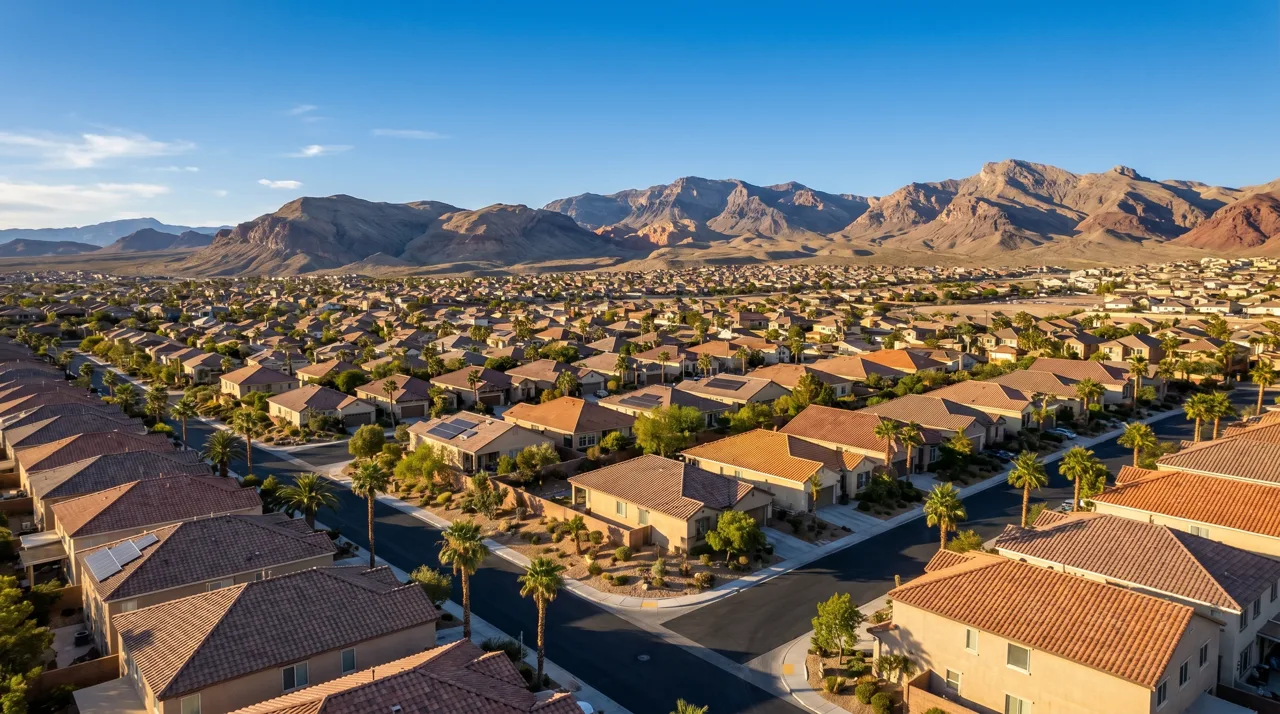
Las Vegas Homes with Water Features: Fountains, Ponds, and Backyard Oases

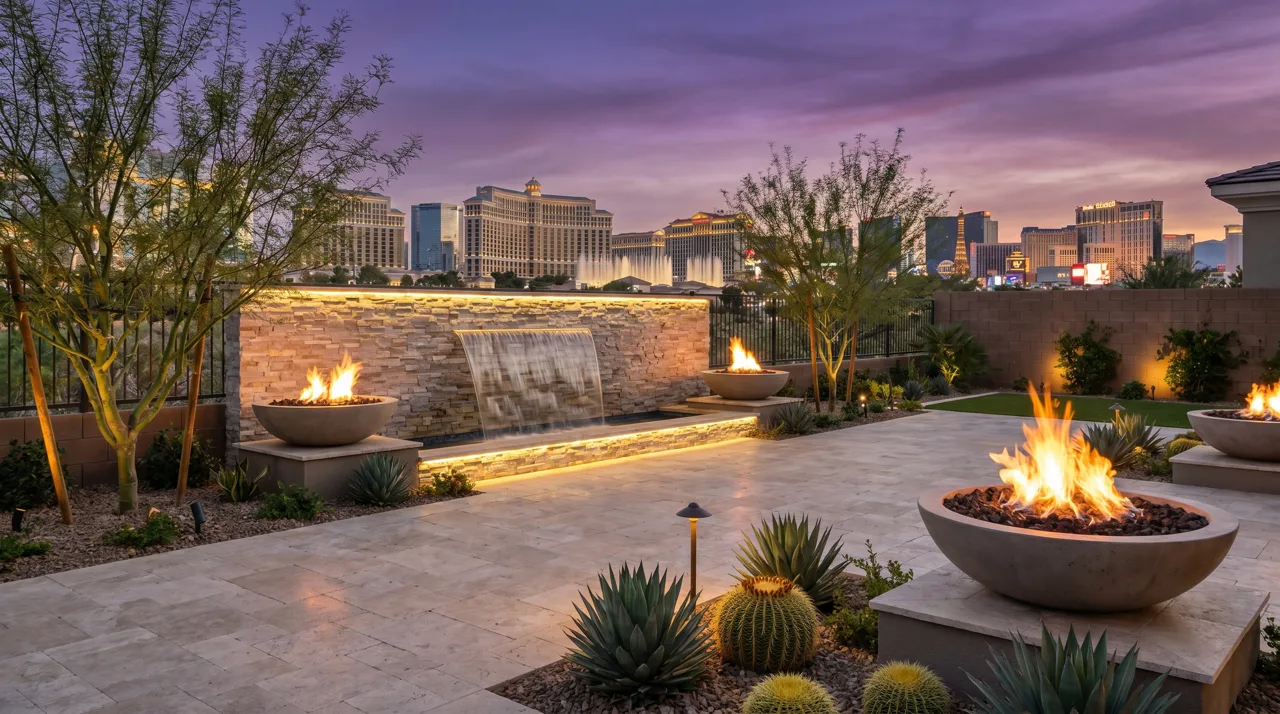
In a city stitched into the Mojave, the sound of moving water in your own backyard hits differently. It cools the air, softens the harsh light bouncing off stucco walls, and turns an ordinary desert lot into something that feels like a hideaway. This Las Vegas water features homes guide walks through what's actually legal, what's worth the money, and which neighborhoods deliver a water-driven lifestyle without the headaches of building one yourself.
Here's the part most articles miss. The rules around backyard fountains and ponds in Southern Nevada changed dramatically over the last decade, and they keep tightening. If you're shopping for a home with a water feature, or planning to add one to a house you already own, the regulations matter more than the design choices. A buyer who walks into a property with a beautiful 200 square foot pond and assumes it's grandfathered in or perfectly legal can be in for an expensive surprise.
Good news: a smart, legal, gorgeous backyard oasis is absolutely still possible here. It just looks different than it does in Phoenix or Palm Springs, and the path to ownership runs through a few specific facts you'll want to understand before you write an offer.
The 10-Square-Foot Rule That Changes Everything
The Las Vegas Valley Water District (LVVWD) sets the rule for ornamental water features at single-family homes, and it's stricter than most buyers expect. Per LVVWD's published service rules and conservation guidance, district water cannot be used for outdoor ornamental water features at single-family homes unless the feature has a surface area of 10 square feet or less, is supplied entirely by privately owned water rights, or is located entirely indoors.
That's it. Those are the categories. A backyard koi pond the size of a hot tub would already be over the limit. A traditional three-tiered front-yard fountain with a wide basin? Almost certainly over. An indoor entry fountain inside the home? Allowed. A small recirculating wall feature with a 9-square-foot basin? Allowed.
So why so strict? It comes down to where Las Vegas water comes from and how it's used. According to the Southern Nevada Water Authority (SNWA), about 90% of the region's water is drawn from the Colorado River, with Nevada's consumptive allocation capped at 300,000 acre-feet per year. Indoor water is recycled at near-total efficiency (around 99% of indoor wastewater goes back into the system), but outdoor water is what the SNWA calls "consumptive use." Once it evaporates from a pond, fountain, or open basin, it's gone. About 60% of the region's water use happens outdoors, and that's the number policymakers have been chipping away at for years.
The results have been remarkable. Per the SNWA, since 2002 the population of Southern Nevada has grown 58% while per-capita water use has dropped 58%, and consumptive use of Colorado River water is down about 40%. Roughly 250 million square feet of grass has been removed across the valley since 1999, saving an estimated 203 billion gallons. Meanwhile, Lake Mead's level has dropped about 160 feet since 2000 according to SNWA, and shortage conditions on the Colorado River have been in effect since 2022. None of this is going to loosen up. If anything, the trend is in the other direction.
Pools Are a Different Animal
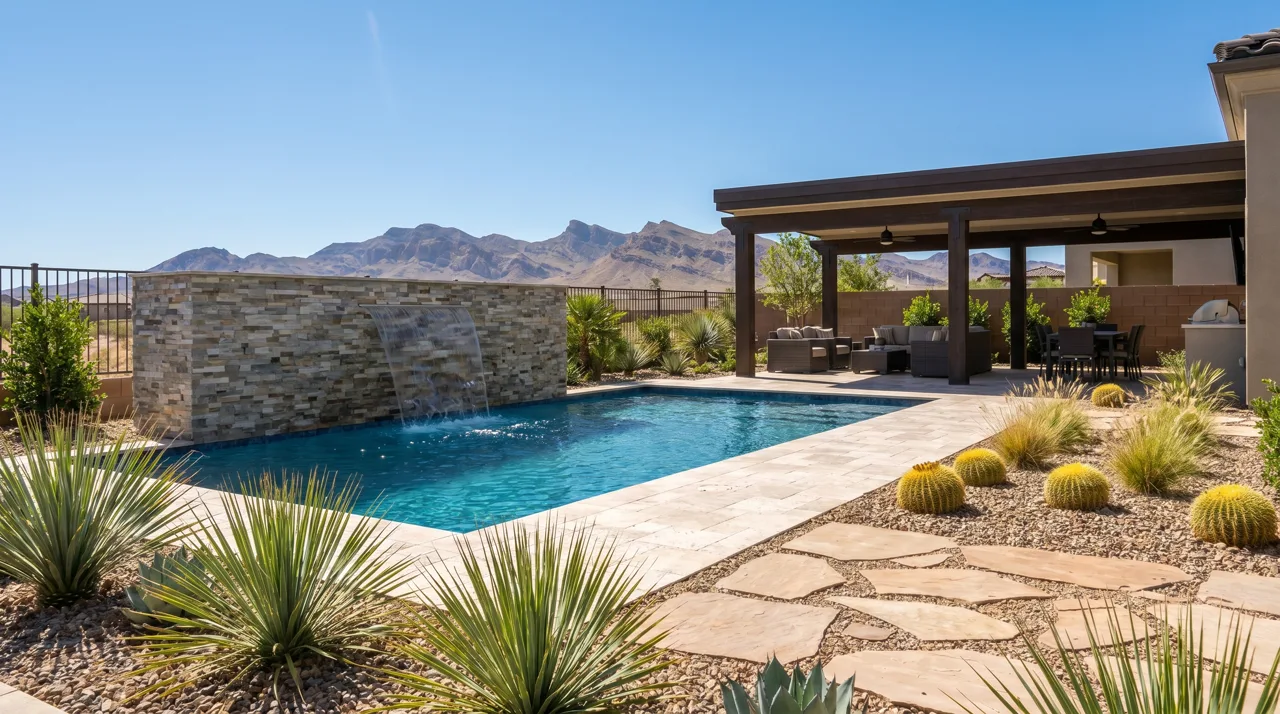
This is where buyers get tripped up. Swimming pools are not classified the same way as ornamental fountains and ponds under LVVWD rules. A pool, with all of its associated waterfalls, scuppers, spillways, and integrated spa overflows, is treated as a swimming pool, not a decorative feature. That's why you can absolutely still buy or build a Las Vegas home with a beautiful pool that includes a cascading waterfall or sheet-water spillover, and it has nothing to do with the 10-square-foot ornamental rule.
That said, pools have their own evolving rules. The SNWA notes that the average residential pool in Southern Nevada is about 475 square feet, and LVVWD's Chapter 3 service rules introduced restrictions for new pools larger than 600 square feet for permits issued after September 1, 2022. Translation: pools are still very much allowed and very much encouraged in this market, but oversized resort-style pools are getting harder to permit on new builds.
For market context, roughly 32% of homes for sale across the Las Vegas Valley feature a private pool or spa as of early 2026, and that share climbs above 90% in the luxury segment over $1 million. According to local pool builders, expect installation costs in the $40,000 to $120,000 range for an inground pool, with most homeowners paying roughly $50 to $125 per square foot before extras like heaters, lighting, and water features. Industry estimates put the value bump at about 5% to 8% on a typical Las Vegas home, though that varies wildly with quality of build and how the pool integrates with the rest of the yard.
What a Pool Actually Costs to Run
The sticker shock comes after closing. A few realistic numbers for Las Vegas pool ownership pulled from local service providers:
| Expense | Typical Range | Notes |
|---|---|---|
| Professional cleaning | $80-$150 / month | Year-round for full-service in this climate |
| Chemicals (DIY) | $15-$25 / month | Higher in summer with heat and use |
| Summer energy uptick | $30-$100 / month | Pumps run more during 110°F stretches |
| Annual upkeep total | $2,000-$2,500 | Concrete pools trend higher; fiberglass lower |
| Major repairs | $700-$3,500 | Pumps, leaks, heaters, resurfacing every 10 yrs |
None of that is meant to talk anyone out of a pool. Owning one in Las Vegas is one of the genuine joys of living here. Just budget like a homeowner, not like a vacationer.
Lake-Centered Communities: The Real "Water Lifestyle" Play
If your dream is waking up to the sound of moving water and watching ducks paddle past your backyard, the smartest move in 2026 isn't to build a private pond. It's to buy into a community that already has a lake. A handful of Las Vegas Valley neighborhoods were built around large bodies of water before current restrictions came into force, and they remain the closest thing to true waterfront living in the desert.
Lake Las Vegas Waterfront
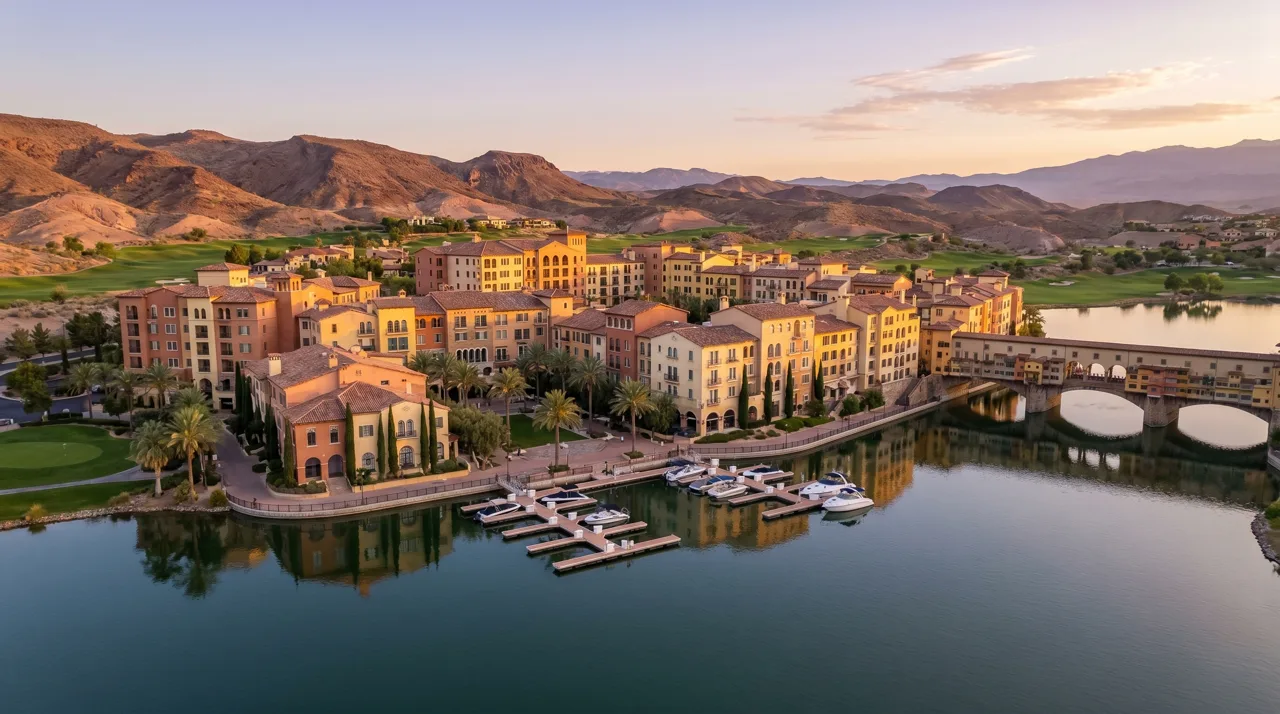
The signature water community in Southern Nevada. Built around a 320-acre manmade lake in Henderson, Lake Las Vegas combines Mediterranean village architecture, two championship golf courses, and the only true private-dock waterfront homes in the metro. The Island at Lake Las Vegas is a smaller pocket within the community offering roughly 140 homesites where lakeside residences can include personal docks, which is a rare thing to even type in a Mojave context. Per recent local market reporting, Lake Las Vegas posted a $644,500 median sale price in mid-2025 with sales volume up nearly 10% year-over-year, even as the broader Las Vegas market softened. If you want the closest thing to a beach-town life in the desert, this is the answer.
Desert Shores
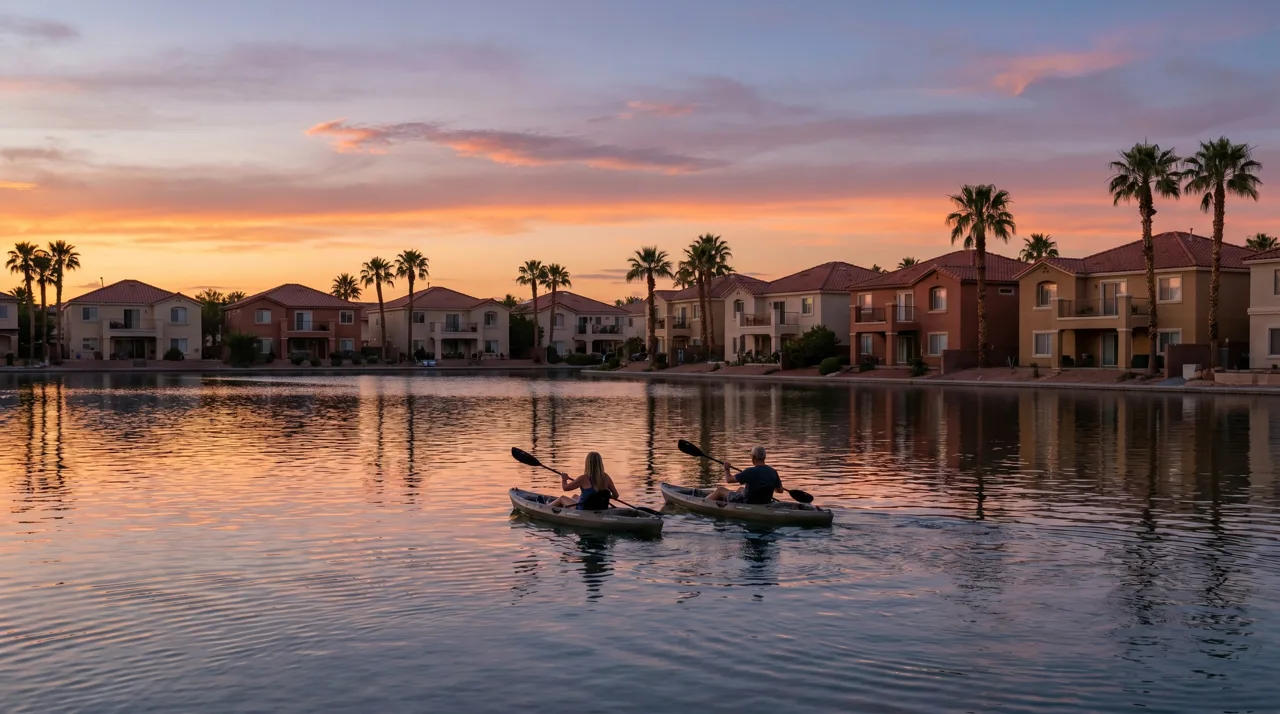
Tucked into the northwest valley, Desert Shores was built around four manmade lakes, a sandy lagoon-style swimming beach, and a network of greenbelts. It's the only place in Las Vegas where you can paddleboard from your backyard for the price of a normal mid-tier home. The lakes are private to community residents, and the city of Las Vegas's planning documents specifically call out the waters at Desert Shores as a notable local feature. For buyers who want a water lifestyle without paying Lake Las Vegas prices, this is usually the answer.
The Lakes
The pioneer. Established in the 1980s on the west side of the valley, The Lakes is a master-planned community organized around a large central lake, with smaller waterway connections threading through neighborhoods. Many homes sit directly on the water, and the community allows non-motorized boating. It feels established because it is, and the mature trees do something for the light that newer parts of town can't replicate yet.
The Fountains
A guard-gated luxury community in Green Valley, Henderson, named for exactly the thing buyers come here looking for. Tree-lined streets, custom homes, and ornamental water features placed throughout the common areas create a distinctly verdant feel that's hard to find elsewhere in Henderson. The water features here are HOA-maintained, which sidesteps the headaches of private upkeep entirely.
Why this matters: in markets like Austin or Atlanta, a backyard pond is a landscaping decision. In Las Vegas, because outdoor water is so heavily restricted at the individual-home level, the practical, premium version of "water-feature living" is usually a community-scale answer, not a private one. Buying into Lake Las Vegas, Desert Shores, or The Lakes lets you enjoy water views, water sounds, and water recreation without becoming personally responsible for an evaporating compliance issue.
What a Compliant Backyard Oasis Actually Looks Like in 2026

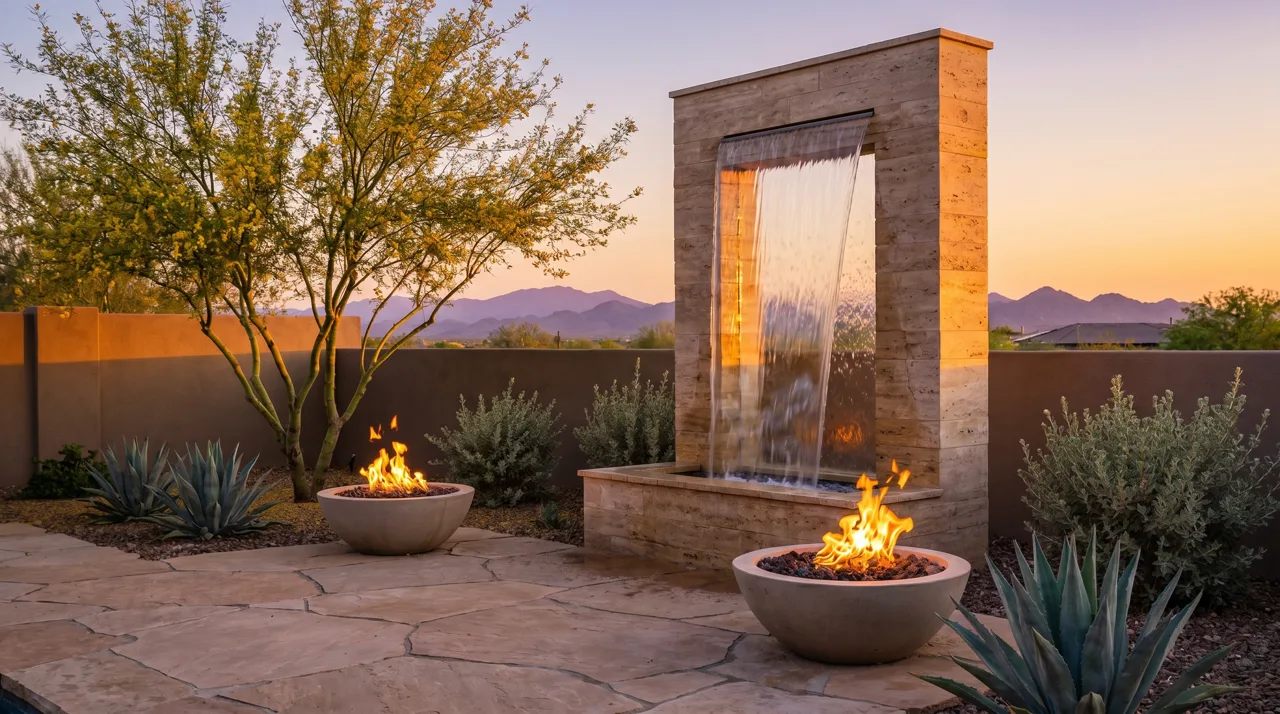
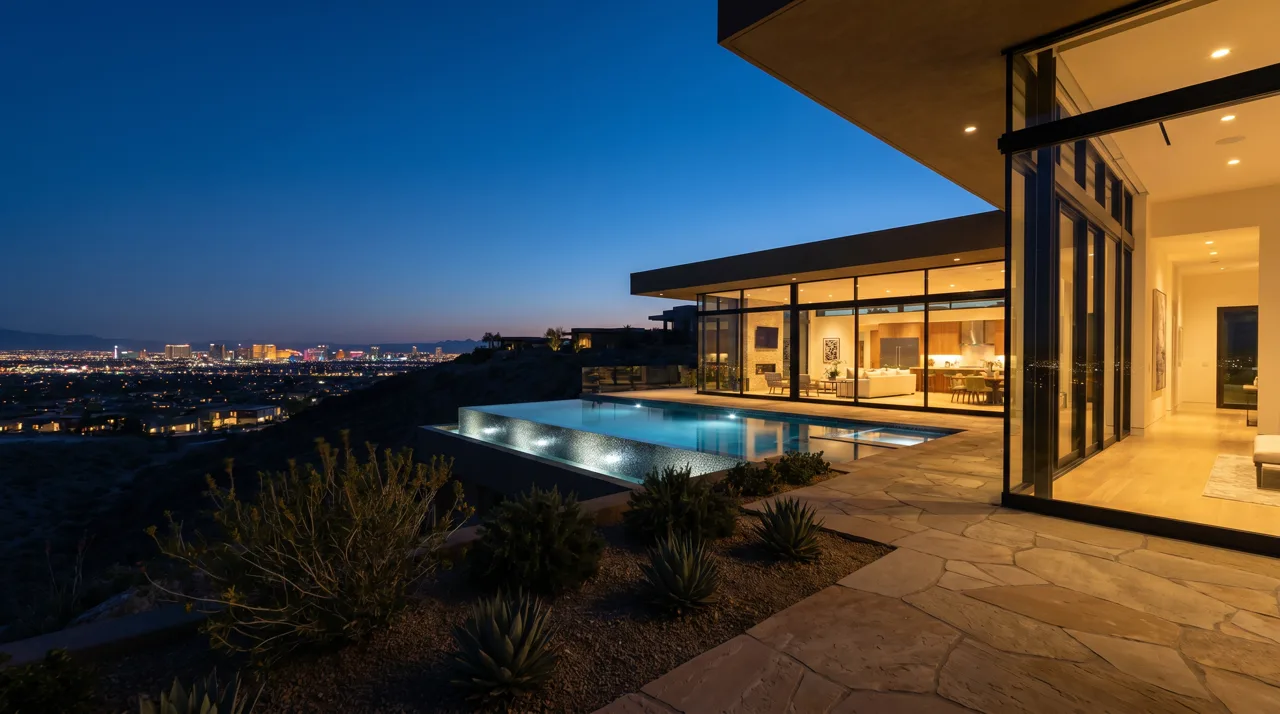
Strip away the regulatory talk and a Las Vegas backyard oasis in 2026 has a very recognizable shape. It usually includes:
- A pool sized to actually fit the family and the lot, not a 1,000 square foot resort knockoff
- An attached spa with spillover into the pool (legal, gorgeous, soothing)
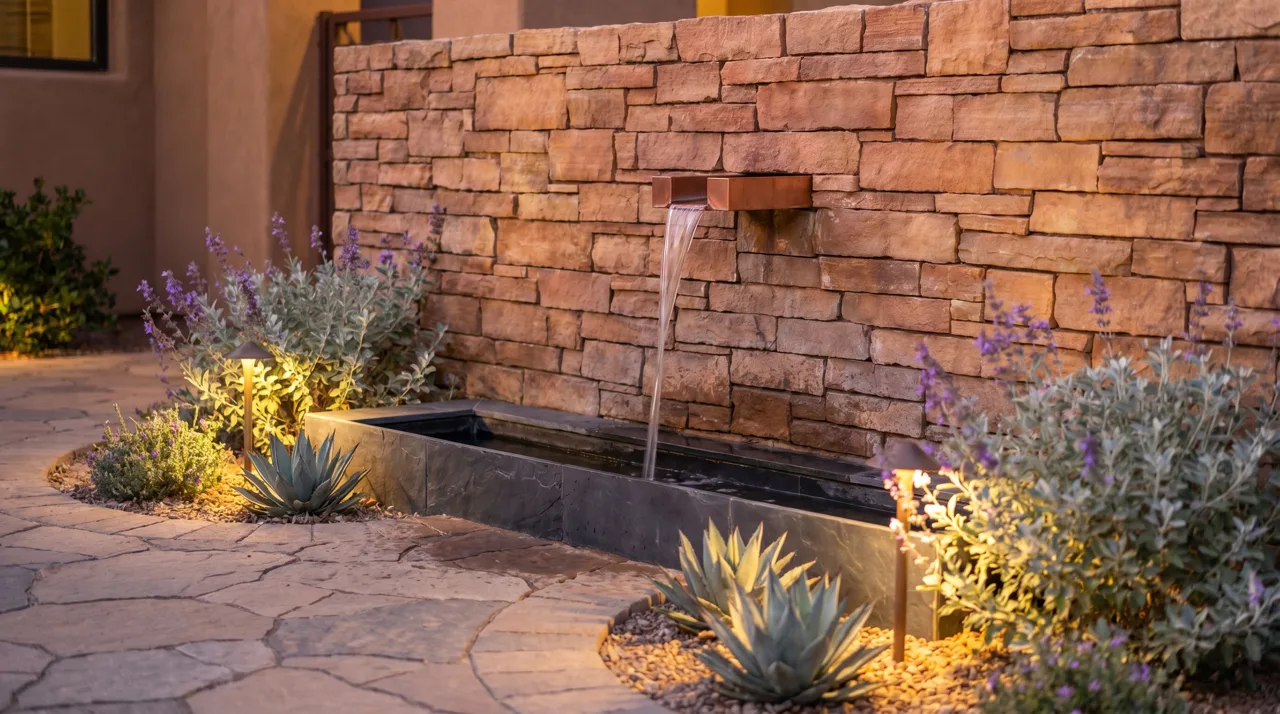
- A small, recirculating ornamental feature: a wall fountain, a narrow rill, or a sheet-water element under 10 square feet
- Fire bowls or a fire pit for shoulder-season nights when it actually gets cold
- Covered patio or shade sail to make the space usable from May through September
- Drought-tolerant plantings on drip irrigation, with mature trees for vertical layering
- Stonework, pavers, and hardscape that hold up to 110°F summers without warping or fading
The best designs around the valley right now lean into vertical water rather than horizontal. A tall, narrow sheet of water moving down a stone or steel wall makes a tremendous visual and acoustic impression while staying compliant. Pondless waterfalls (the kind that recirculate through a hidden basin under decorative rock) are also having a moment. They give you the sound of falling water without any open surface area at all, and they sidestep the mosquito and algae problems of traditional ponds.
Hidden Costs Most Buyers Don't See Until It's Too Late
Beyond the obvious utility and chemistry costs, water features in Las Vegas come with a few expense categories that don't show up in a typical home inspection checklist.
Mosquitoes Aren't a Joke Here
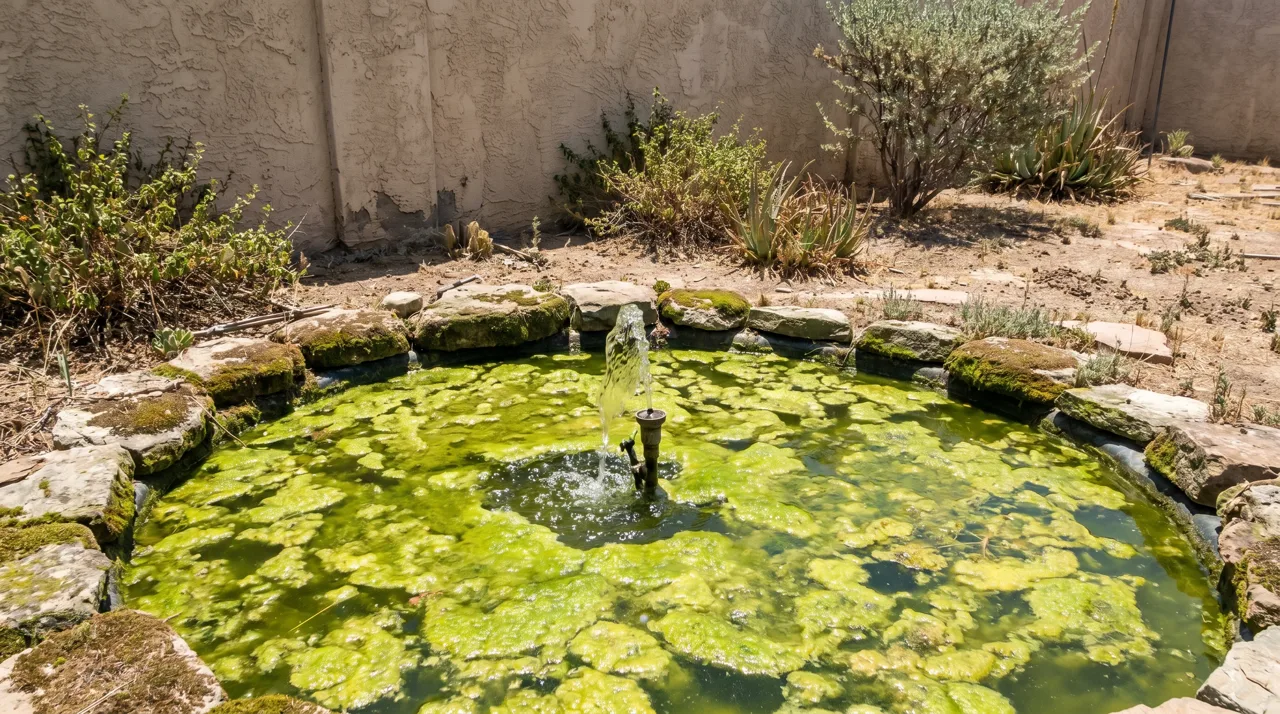
The Southern Nevada Health District (SNHD) warns that mosquito larvae can develop in standing water in 7 to 10 days, and that ornamental ponds and pools should be aerated with a fountain or bubbler, or stocked with mosquito-eating fish to keep larvae from establishing. Counterintuitively, SNHD notes that chlorine alone will not kill mosquito larvae in untreated standing water, which surprises a lot of pool owners who assume their chemistry takes care of it.
This isn't theoretical. Per SNHD reporting, by early June 2024 the district had identified 91 mosquito pools containing more than 3,000 mosquitoes across 16 ZIP codes that tested positive for West Nile virus. That was the highest level of early-season activity SNHD had recorded at that point. Aedes aegypti was first trapped in Clark County in 2017, and surveillance has expanded since. If you buy a home with a neglected pond, fountain, or unmaintained pool, you're not just inheriting an aesthetic project; you're potentially inheriting a public-health one.
The SNWA Rebate Trap
This one is genuinely obscure and catches buyers off guard. Under the SNWA's Water Smart Landscapes rebate program, homeowners get paid to convert grass to drip-irrigated desert landscaping. Once an area has been converted under that program, the agreement prohibits future installation of swimming pools, ponds, other bodies of water, or water features in the converted area. So if you buy a home where the previous owner cashed a Water Smart rebate check, certain parts of the yard may be permanently off-limits for adding water features later, even if you'd otherwise be within the rules.
Permits, Wind Sensors, and Code Updates
Clark County requires permits for pools, spas, and water features through its Building and Fire Prevention Department. According to the county's Swimming Pool/Spa, Water Feature Building Permit Guide, plan submittals must include site drainage details, barrier and setback information, and (interesting one) wind sensors for water features in some cases. Most residential pool permits are reviewed over the counter, and many are issued on the first visit. Worth knowing: Clark County adopted the 2024 International Building Codes effective January 11, 2026, including the 2024 International Swimming Pool and Spa Code with Southern Nevada amendments. If you're remodeling or adding to an existing feature, your contractor needs to be working from the current code, not the one they used last year.
Buyer Due Diligence Checklist
If you're seriously considering a Las Vegas home with any kind of fountain, pond, or major outdoor water feature, run through this list before you remove your inspection contingency:
Before You Make an Offer
- Is the ornamental feature 10 square feet or less by surface area, or is it indoors? If yes, you're in the clear under LVVWD's rule
- If the feature is part of a pool or spa system (not freestanding), confirm that in writing with the listing agent
- Ask whether the home participated in the SNWA Water Smart Landscapes rebate program, and if so, where the converted areas are
- Pull the permit history for the pool and any water features through Clark County or the relevant city building department
- Check the HOA design rules. Master-planned communities often have stricter standards than the municipal code
- Walk the property looking for standing water, algae, dead pumps, or any feature that's clearly not running
- Get the equipment age. Pumps last 7 to 12 years; heaters about 10. A 15-year-old system is a near-term replacement
- Budget the actual maintenance load before you buy. The romance of a backyard waterfall fades fast at 11 PM in July when the pump quits
This is also where having an agent who's actually closed deals on water-feature properties matters. As a CRS designated agent (held by under 3% of Realtors nationally) and someone who's worked through more than 600 transactions in this valley, I've seen plenty of these come up at inspection. The fix is almost always negotiable if you know to ask. The trap is closing on a feature that's out of compliance and inheriting the legal and financial cleanup yourself.
Are Water Feature Homes Actually Worth More?
Short answer: yes, but probably not in the way the listing photos suggest.
For pools specifically, local market behavior backs up the 5% to 8% value premium estimate. In a desert metro where summer outdoor temperatures sit above 100°F for roughly three months, a pool isn't a luxury, it's an amenity that materially changes how the home gets used May through September. Buyers know that, and homes without pools in family-oriented price ranges often sit longer than equivalent homes that have one.
Standalone ornamental features are harder to put a number on. A small, well-designed wall fountain in a thoughtful entry courtyard reads as architectural quality and probably nudges the home's appeal upward, but it's not going to add a measurable dollar premium on its own. What it can do is move a buyer from "interested" to "writing the offer," which is usually worth more than any specific dollar figure.
The biggest premium in this space lives at the community level. Lake Las Vegas waterfront homes have consistently traded at significant multiples over comparable square footage in non-waterfront Henderson neighborhoods, and Desert Shores lakefront homes regularly outprice interior streets within the same community by 15% or more. If you want water to translate into resale value, buy a view of someone else's water responsibility.
Where to Look First, Depending on the Lifestyle You Want
| What You Want | Where to Look | Typical Price Range |
|---|---|---|
| True waterfront with a private dock | Lake Las Vegas (The Island) | $1.5M-$10M+ |
| Lakeside living at a normal Vegas price | Desert Shores, The Lakes | $500K-$1.2M |
| Resort pool + small water accents | Summerlin, Southern Highlands | $700K-$2M |
| Ultra-luxury custom with elaborate features | The Ridges, MacDonald Highlands | $2M-$15M+ |
| Established golf course living with HOA fountains | Anthem Country Club, Seven Hills | $700K-$3M |
Notice that the entry point for a real water lifestyle in Las Vegas isn't extreme. You don't have to spend $5 million to wake up next to water here. You just have to buy in a community that did the heavy lifting for you decades ago.

Frequently Asked Questions
Can you have a fountain at your Las Vegas home?
Yes, with limits. Outdoor ornamental fountains at single-family homes are allowed by LVVWD if the surface area is 10 square feet or less, the feature is supplied by privately owned water rights, or the feature is located entirely indoors. Anything larger or open to the air is generally prohibited.
Are ponds allowed in Las Vegas backyards?
The same 10-square-foot ornamental rule applies. A traditional koi pond at any meaningful size is going to be over the limit. If you want the koi-pond feeling without the regulatory issues, look at pondless waterfalls or buy in a lake-centered community.
What size water feature is allowed at a single-family home in Las Vegas?
Per LVVWD service rules, 10 square feet of surface area is the cap for outdoor ornamental water features at single-family homes that use district water. Indoor features are not subject to that surface-area cap.
Are indoor fountains legal in Las Vegas?
Yes. LVVWD's restriction on ornamental water features specifically excludes features located entirely indoors. Indoor entry fountains, water walls, and atrium features are allowed. The reason: indoor water in Southern Nevada is recycled at near-total efficiency, while outdoor water evaporates and is considered consumptive use.
Do Las Vegas HOAs allow backyard water features?
Sometimes more strictly than the city does. Master-planned communities can layer their own design rules on top of municipal code, and luxury HOAs frequently require architectural review before any water feature is installed. Always pull the CC&Rs and check with the HOA directly before you assume a 10-square-foot fountain is automatically approved.
Can a previous landscaping rebate affect future backyard upgrades?
Yes, and this catches a lot of buyers off guard. If a prior owner participated in the SNWA Water Smart Landscapes rebate program, the converted areas may be permanently restricted from later additions like pools, ponds, or water features. Ask for the rebate paperwork as part of due diligence.
Will a water feature add to my home's value?
Pools generally add roughly 5% to 8% to a Las Vegas home's value, with bigger gains for thoughtfully integrated builds. Standalone ornamental fountains rarely add measurable dollar value on their own, but they do help homes show better and move faster. The biggest value plays are community-scale: Lake Las Vegas waterfront, Desert Shores lakefront, and similar settings.
What happens to my water bill if I add a pool and a small fountain?
Expect a noticeable summer increase. Pools lose water to evaporation in this climate (a typical 475 square foot pool can evaporate dozens of gallons on a hot, dry day), and small fountains lose water too, just on a smaller scale. Covers, low-flow fill valves, and shade help. Per the SNWA, outdoor use accounts for around 60% of Southern Nevada residential water consumption, and your bill will reflect that pattern.
Las Vegas hasn't given up on backyard oases, it's just gotten a lot more thoughtful about what one looks like. The version that works in 2026 is smaller, smarter, and frequently borrows the best part (the actual water) from a community that's already doing it at scale. Whether you're house-hunting in Lake Las Vegas, eyeing a pool home in Summerlin, or considering a custom build in The Ridges with a small entry fountain and a serious pool program, the design choices and the regulatory choices are joined at the hip. Get them both right and the desert becomes the most interesting backdrop a backyard can have.
If you'd like a personal walkthrough of any of these communities, or you want a free home valuation on a property with existing water features that you're thinking about selling, the phone is always answered. The Las Vegas Valley Water District publishes its current rules at lvvwd.com, and the SNWA's water resource and rebate information lives at snwa.com for anyone who wants to read the source material directly before making a move.
Categories
Recent Posts